Breaking Down Bioavailability: Why All Magnesium Isn't Equal
Not all magnesium is created equal. The form you choose determines whether your body absorbs 4% or 80% of every dose.

D.C.
Doctor of Chiropractic
Founder of FormulaForge. Doctor of Chiropractic revolutionizing nutritional supplements to be what we all wish they were — real quality, scientifically validated, with the exact ingredients and dosages we choose.
View Full ProfileMagnesium oxide absorbs at approximately 4%, while glycinate absorbs at approximately 80%. The form of magnesium you choose determines whether your supplement actually delivers meaningful nutritional value. This article compares the seven most common magnesium forms by published bioavailability data and explains what to look for on your label.
Breaking Down Bioavailability: Why All Magnesium Isn't Equal
Reviewed by Dr. Brennan Commerford, D.C.
You take 500 mg of magnesium every day. But your body might only be absorbing 20 mg of it.
That is not a labeling error. It is the reality of bioavailability—the percentage of a nutrient that actually reaches your bloodstream after you swallow it. And when it comes to magnesium, the gap between forms is one of the widest in all of nutrition.
Research suggests that roughly 75% of Americans fall short of the recommended daily magnesium intake. Many of those people are taking a supplement—it just uses a form their body can barely absorb. The result: wasted money, persistent deficiency symptoms, and a false sense of security.
In this guide we break down what bioavailability means, compare the most common magnesium forms side by side, and show you how to calculate whether your supplement is actually working. The data may change how you think about every bottle in your cabinet.
What Is Bioavailability, and Why Does It Matter?
Bioavailability is the fraction of an ingested nutrient that survives digestion, crosses the gut wall, and enters systemic circulation where your cells can use it. A supplement with 4% bioavailability delivers 4% of the stated dose to your body. The other 96% passes straight through.
The Dose vs. Absorbed Equation
The math is straightforward:
Absorbed amount = Dose × Bioavailability %
Applied to two common magnesium forms, that equation tells a striking story:
- 500 mg magnesium oxide (roughly 4% bioavailability) = approximately 20 mg absorbed
- 200 mg magnesium glycinate (roughly 80% bioavailability) = approximately 160 mg absorbed
The glycinate dose is less than half the size on the label, yet it delivers eight times more magnesium to your cells.
Why Bioavailability Varies Between Forms
Several factors determine how much of a mineral your body can use:
- Molecular form. The molecule a mineral is bound to—an amino acid, an organic acid, an inorganic salt—directly affects how easily it crosses the intestinal lining.
- Gastric pH. Some forms require high stomach acid to dissolve. Low stomach acid (common in adults over 50 and anyone on PPIs) reduces absorption further.
- Mineral competition. Calcium and iron compete for the same absorption pathways. Taking them together lowers both.
- Individual physiology. Digestive health, medication use, and age all shift absorption rates.
The Hidden Cost of Low Bioavailability
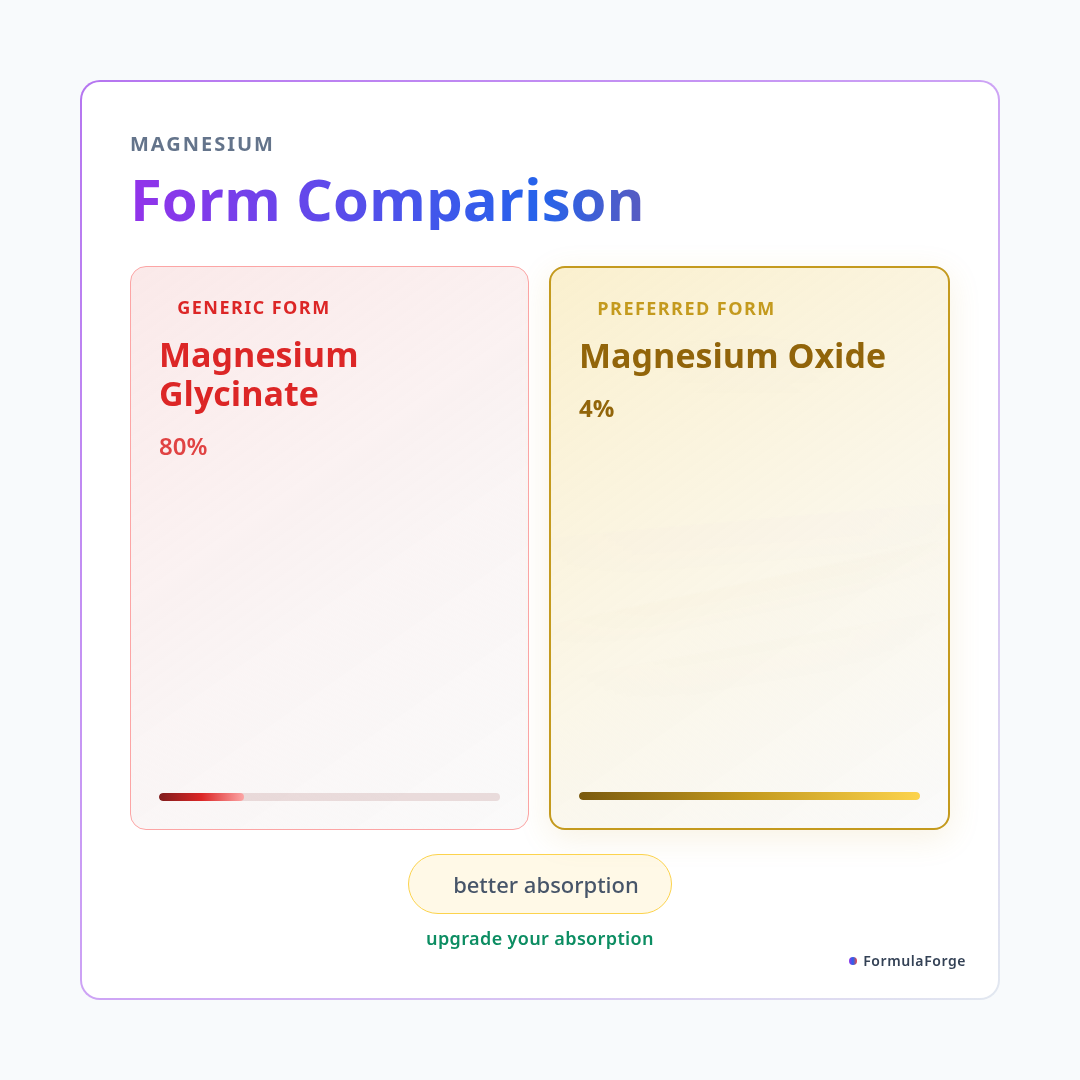
When you buy a bottle labeled “500 mg Magnesium” and only 20 mg reaches your blood, you are paying full price for a 96% waste rate. That is not a bargain—it is an expensive way to get very little magnesium.
The molecular form a mineral is bound to directly determines how much crosses the intestinal lining. Chelated forms like glycinate protect the mineral through stomach acid, delivering significantly more to your bloodstream than inorganic forms like oxide.
The Magnesium Form Comparison
Not every magnesium supplement belongs on the same shelf. The table below summarizes the most widely available forms, ranked by research-backed bioavailability estimates.
| Form | Estimated Bioavailability | Research-Supported Uses | Relative Cost | FormulaForge Classification |
|---|---|---|---|---|
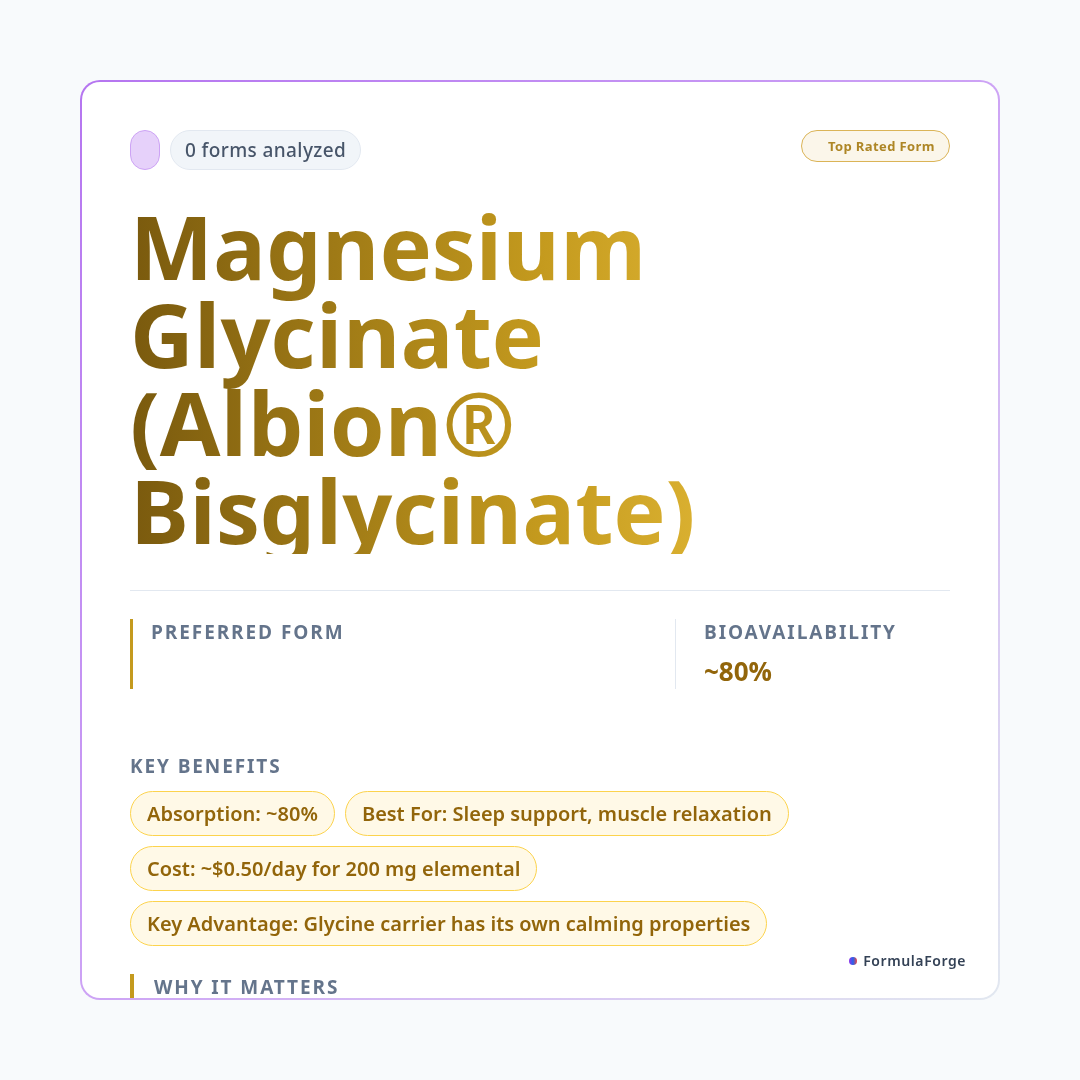
| Albion® Magnesium Bisglycinate (Glycinate) | ~80% | Sleep support, muscle relaxation, general replenishment | $$$ | Premium (score 90+) |
| Magnesium Malate | ~70–80% | Energy metabolism, muscle comfort | $$$ | Premium (score 85+) |
| Magnesium Threonate (Magtein®) | ~60–70% | Cognitive function, crosses blood-brain barrier | $$$$ | Premium (score 85+) |
| Magnesium Taurate | ~40–50% | Heart and muscle function support | $$$ | Standard (score 70-84) |
| Magnesium Citrate | ~30–40% | General deficiency, mild constipation relief | $$ | Standard (score 70-84) |
| Magnesium Oxide | ~4–10% | Laxative effect (not ideal for replenishment) | $ | Alternative (score under 50) |
| Magnesium Sulfate (Epsom Salt) | Topical only | Baths, soaks—not oral supplementation | $ | N/A |
Individual results may vary. Bioavailability ranges are derived from published clinical and preclinical studies. Consult a healthcare professional for personalized guidance.
To absorb the same amount of magnesium from oxide as you would from a single 200 mg glycinate capsule, you would need to take roughly 4,000 mg of oxide. At that dose, severe GI distress would be virtually guaranteed.
Magnesium Glycinate: Why It Earns a Premium Score
Glycinate (also sold as bisglycinate, with Albion® being the most-cited patented form) chelates magnesium to the amino acid glycine. This bond protects the mineral through the acidic stomach environment, allowing it to reach the small intestine largely intact. Glycine itself has calming properties, which may explain why glycinate is the form most commonly associated with improved sleep quality in observational reports.
At roughly $0.50 per day for 200 mg elemental magnesium, glycinate costs more than oxide up front—but as the absorbed-dose math shows, the effective cost per milligram your body uses is substantially lower.
Magnesium Malate: The Energy Form
Malate binds magnesium to malic acid, a compound involved in the Krebs cycle (your cells' primary energy-production pathway). Research has explored its potential role in supporting people with fibromyalgia and chronic fatigue. With bioavailability in the 70–80% range, malate sits alongside glycinate in the Premium score band.
Magnesium Oxide: The 4% Problem
Oxide is the form you will find in most budget supplements. It is cheap to manufacture, and because magnesium oxide is 60% elemental magnesium by weight, brands can print impressively large numbers on the label. But published absorption data tells a different story: only about 4% of that dose enters circulation.
The practical implication: you would need to take roughly 10,000 mg of magnesium oxide to absorb the same amount you get from 500 mg of glycinate. At that dose, severe GI distress is virtually guaranteed.
Why Budget Supplements Default to Oxide
If oxide is so poorly absorbed, why is it the industry standard? The answer is economics.
Manufacturing Economics
- Oxide raw cost: approximately $0.05/gram
- Glycinate raw cost: approximately $0.15/gram (3× more)
- Per-bottle cost difference: roughly $2 for oxide vs. $6 for glycinate
At retail, a $10 oxide bottle yields a 400% markup. A $25 glycinate bottle yields around 317%. Oxide is more profitable despite being less effective.
The Label Optics Problem
Consumers naturally equate bigger numbers with better value. A bottle that reads “Magnesium 500 mg” without specifying a form looks like a better deal than one that reads “Magnesium (as Glycinate) 200 mg.” Most shoppers do not realize that the 200 mg glycinate delivers eight times more usable magnesium than the 500 mg of (likely) oxide.
The “Cheap Is Expensive” Paradox
When you calculate cost per absorbed milligram, the math flips:
- Oxide: $10/month ÷ ~600 mg absorbed per month = roughly $0.017 per absorbed mg
- Glycinate: $25/month ÷ ~4,800 mg absorbed per month = roughly $0.005 per absorbed mg
Glycinate is approximately 3× more cost-effective per absorbed milligram, despite a higher sticker price. The cheapest supplement is the one that actually works.
Most supplement labels say “Magnesium 500mg” without specifying the form. Consumers cannot tell whether they are getting oxide (4% absorbed) or glycinate (80% absorbed) without reading the fine print on the Supplement Facts panel.
When you scan your supplement label at myformulaforge.com, our system identifies every ingredient form automatically and shows you the actual absorption profile. No guessing, no fine-print reading required.
How to Identify High-Bioavailability Magnesium on Any Label
The 30-Second Label Check
Turn the bottle around and look at the Supplement Facts panel. You want to see the form spelled out:
- “Magnesium (as Magnesium Glycinate)” — Transparent. You know exactly what you are getting.
- “Magnesium 500 mg” with no form listed — Almost always oxide. Brands that use premium forms name them.
Elemental vs. Compound Weight
A common source of confusion: the milligram number on the label may refer to the compound weight or the elemental magnesium weight. They are not the same.
- Glycinate: roughly 14% elemental magnesium. So 700 mg of magnesium glycinate provides about 100 mg of elemental magnesium.
- Oxide: roughly 60% elemental magnesium. So 200 mg of magnesium oxide provides about 120 mg of elemental magnesium.
This is one reason oxide labels display larger numbers—more of the compound's weight is magnesium itself, with less carrier molecule. But that advantage disappears when you factor in the 4% absorption rate.
Calculate Your Effective Dose
Effective dose = Elemental magnesium × Bioavailability %
Example: 200 mg elemental from glycinate × 80% = 160 mg absorbed
Example: 200 mg elemental from oxide × 4% = 8 mg absorbed
Red Flags for Low-Quality Magnesium
- No form specified — if the label just says “Magnesium,” assume oxide.
- Doses above 500 mg elemental — only oxide needs that much to be even marginally useful.
- Price below $0.20/day — too inexpensive to contain glycinate or malate at a meaningful dose.
- “Compare to Milk of Magnesia” — a product designed as a laxative, not a supplement.
How to Upgrade Your Magnesium in Four Steps
- Check your current form. Read the Supplement Facts panel.
- If it is oxide, switch to glycinate or malate. These are the most widely available high-bioavailability forms.
- Reduce the dose number, increase the absorption. Going from 500 mg oxide to 200 mg glycinate means a smaller pill load and roughly eight times more absorbed magnesium.
- Monitor your results. Many people report improvements in sleep quality, muscle comfort, and mood within two to four weeks of switching forms. Individual timelines vary.
A 2003 randomized, double-blind trial found that magnesium citrate was significantly more bioavailable than magnesium oxide in healthy volunteers. — Walker AF, et al. Magnesium Research, 16(3), 183–191.
Bioavailability Is Not Just a Magnesium Problem
The gap between high- and low-bioavailability forms exists across dozens of nutrients. Here are some of the most significant examples.
Folate
- Quatrefolic® Methylfolate / 5-MTHF (Premium): The active form. Bypasses the MTHFR enzyme entirely.
- Folic acid (Alternative): Synthetic. Requires enzymatic conversion that roughly 40% of the population performs poorly due to common MTHFR gene variants.
- Gap: Up to 7× for individuals with MTHFR polymorphisms.
CoQ10
- Ubiquinol (Premium): The reduced, active form. Ready for mitochondrial use immediately.
- Ubiquinone (Standard): The oxidized form. Your body must convert it before use, a process that becomes less efficient with age.
- Gap: Research suggests ubiquinol achieves 2–4× higher plasma levels than the same dose of ubiquinone, with the difference widening in older adults.
Vitamin D
- D3 / Cholecalciferol (Premium): The same form your skin produces in sunlight. More effective at raising and maintaining serum 25(OH)D levels.
- D2 / Ergocalciferol (Alternative): Plant-derived, less stable in storage, and research indicates it is roughly 70% less potent at maintaining blood levels over time.
- Gap: Approximately 1.7×.
Curcumin (Turmeric)
- LONGVIDA®, Meriva®, BCM-95®, or liposomal formulations (Premium): Dramatically higher absorption due to lipid encapsulation or specialized delivery technology.
- Standard turmeric extract (Alternative): Less than 1% oral bioavailability without enhancement.
- Gap: Published comparisons show differences of up to 29× depending on the delivery technology used.
Iron
- Ferrous bisglycinate (Albion®, Premium): Chelated, gentle on the stomach, well-absorbed.
- Ferrous sulfate (Alternative): The form most commonly prescribed, but associated with higher rates of GI side effects and lower relative absorption.
- Gap: Approximately 4×.
Vitamin B12
- Methylcobalamin (Premium): Active coenzyme form, no conversion required.
- Cyanocobalamin (Alternative): Synthetic, must be converted through multiple steps.
- Gap: 2–3×, with greater significance for individuals with impaired methylation.
The pattern is consistent: the form you choose matters as much as—or more than—the dose printed on the label. This applies to minerals, vitamins, antioxidants, and botanical extracts alike.
Roughly 40% of people carry a common variant in the MTHFR gene that reduces their ability to convert folic acid into its active form. For these individuals, supplementing with methylfolate (Quatrefolic® 5-MTHF) rather than folic acid can make a meaningful difference in folate status.
Every formula built at myformulaforge.com automatically uses the highest-absorption form of each ingredient. When you upload a label containing magnesium oxide, our system identifies it, upgrades to glycinate or malate, and adjusts the dose so you get the same therapeutic effect from a smaller, better-absorbed capsule. Fewer fillers. Often fewer pills. Research-backed quality.
The bioavailability principle applies across dozens of nutrients, not just magnesium. Folate, B12, CoQ10, curcumin, iron, and vitamin D all have forms that absorb dramatically better than their commodity alternatives.
Case Study: From 500 mg of Nothing to 200 mg That Works
Note: This is a composite example based on commonly reported supplement-switching experiences. Individual results may vary. This is not medical advice.
The situation: Consider a representative example: a person who has been dealing with muscle cramps, disrupted sleep, afternoon fatigue, and occasional anxiety. Her doctor recommends magnesium supplementation.
First Attempt: Magnesium Oxide, $10/Month
This person picks up a popular drugstore brand: Magnesium 500 mg (oxide). She takes one capsule daily for six weeks. No meaningful improvement.
The math: 500 mg oxide × 4% bioavailability = roughly 20 mg absorbed per day. The recommended daily intake for women her age is 310 mg. She is getting about 6% of what she needs.
The Switch: Magnesium Glycinate, $28/Month
After researching forms online, this person switches to magnesium glycinate, taking 120 mg elemental magnesium three times per day (360 mg total). Within two weeks, she notices improved sleep and fewer muscle cramps.
The math: 360 mg glycinate × 80% bioavailability = roughly 288 mg absorbed per day. That puts her within the recommended range.
The Cost-Effectiveness Comparison
| Metric | Magnesium Oxide | Magnesium Glycinate |
|---|---|---|
| Monthly cost | $10 | $28 |
| Daily absorbed dose | ~20 mg | ~288 mg |
| % of RDA met | ~6% | ~93% |
| Cost per absorbed mg | $0.50/mg | $0.097/mg |
| Symptom improvement | None after 6 weeks | Noticeable within 2 weeks |
The glycinate is roughly five times more cost-effective per absorbed milligram, despite costing nearly three times more at checkout.
How FormulaForge Handles Bioavailability
At FormulaForge, every ingredient in your personalized formula is scored on bioavailability before it reaches your bottle:
- Premium (score 85+): The highest-bioavailability forms available for each nutrient. For magnesium, that means Albion® Bisglycinate or malate—never oxide.
- Standard (score 70-84): Well-absorbed forms with strong research support, like citrate or taurate.
- Alternative (score typically under 70): Forms with limited absorption. These are flagged in our system and never used as defaults.
When you upload your current supplement label to our Formula Builder, our system reads each ingredient, identifies the form, and shows you exactly where it falls on the bioavailability spectrum. If your magnesium is oxide, you will see it—along with the premium alternative and the difference in absorbed dose.
This is not about selling you a more expensive product. It is about making sure every dollar you spend on supplements delivers measurable nutritional value. A $28 bottle that works is a better investment than a $10 bottle that does not.
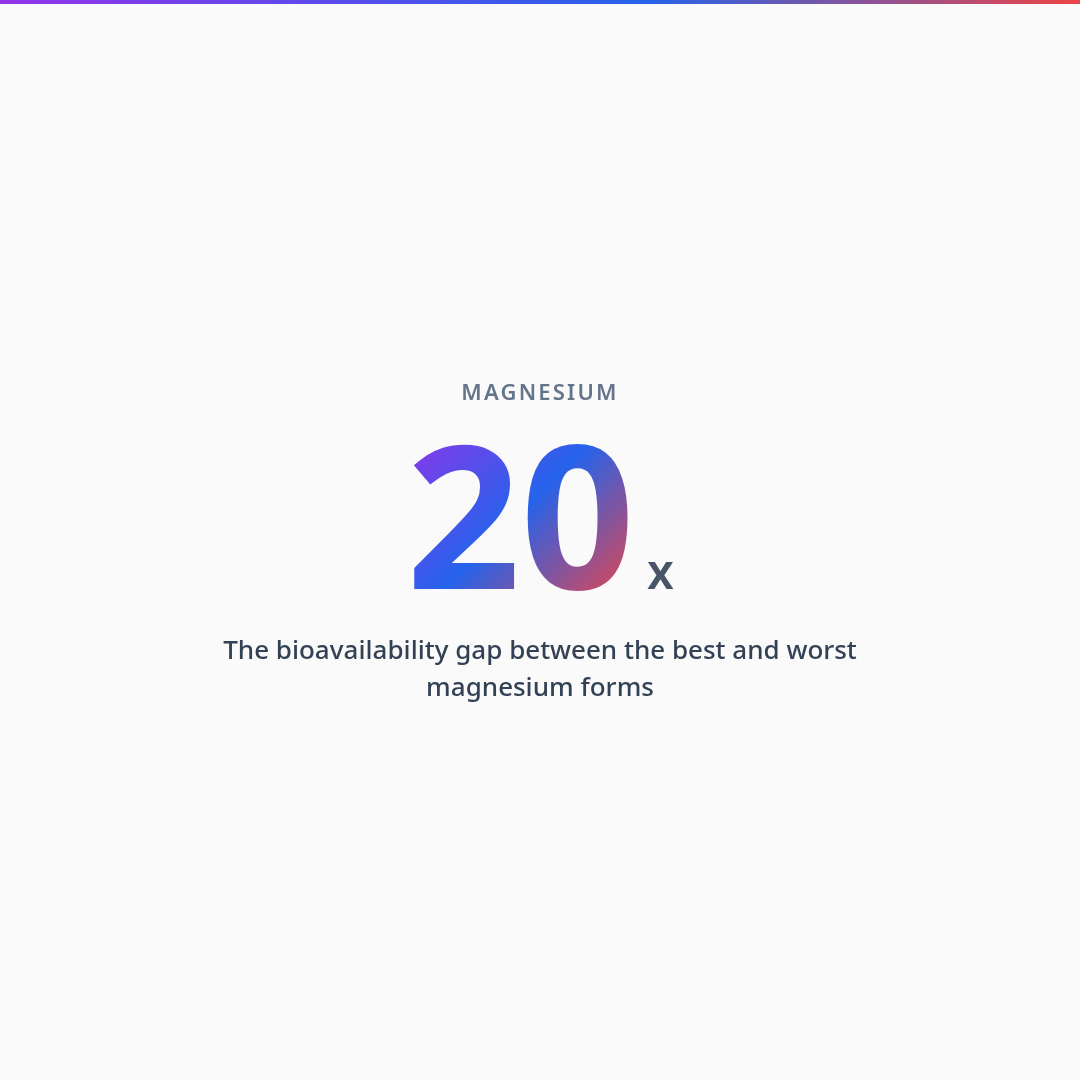
Bioavailability is not a marketing buzzword — it is the single biggest factor in whether a supplement actually does what it claims. Magnesium oxide absorbs at roughly 4%. Glycinate absorbs at roughly 80%. That is a 20x difference. A higher sticker price often means a lower cost per absorbed milligram. The same principle applies across B12, folate, CoQ10, curcumin, iron, and vitamin D.
Frequently Asked Questions
What is the best form of magnesium to take?
For general supplementation, research supports magnesium glycinate (bisglycinate, such as Albion® Bisglycinate) as one of the best-absorbed forms. It is well-tolerated, has calming properties from the glycine carrier, and consistently shows high bioavailability in published studies. Magnesium malate is another strong option, particularly for those focused on energy support. The best form for you depends on your health goals—consult a healthcare professional for personalized guidance.
Why is magnesium oxide so common if it is poorly absorbed?
Magnesium oxide is the cheapest form to manufacture and allows brands to print large milligram numbers on labels, which appeals to consumers who equate bigger doses with better products. Its raw material cost is roughly one-third that of glycinate. Despite having only 4–10% bioavailability, it dominates the budget supplement market because of these economic incentives.
How much magnesium do I actually need per day?
The National Institutes of Health recommends 310–320 mg per day for adult women and 400–420 mg per day for adult men. These are absorbed amounts. If you are taking a low-bioavailability form, you may need a much larger dose to meet these targets—or you can switch to a higher-bioavailability form and take less. Individual needs vary based on diet, health status, and medications.
Can I take too much magnesium?
The tolerable upper intake level for supplemental magnesium is 350 mg per day for adults (this does not include magnesium from food). Exceeding this primarily causes GI symptoms like diarrhea, particularly with poorly absorbed forms like oxide and citrate. Glycinate tends to be gentler on the GI tract at equivalent doses. Talk to your doctor before significantly changing your magnesium intake, especially if you have kidney concerns.
Is magnesium glycinate worth the extra cost?
When measured by cost per absorbed milligram rather than cost per bottle, glycinate is typically more cost-effective than oxide. You need less of it to reach the same absorbed dose, and you avoid the GI side effects that often come with high-dose oxide. For most people, the higher sticker price translates to better value.
The Bottom Line
Bioavailability is not a marketing buzzword. It is the single biggest factor in whether a supplement actually does what it claims. For magnesium specifically:
- Oxide absorbs at roughly 4%. Glycinate absorbs at roughly 80%. That is a 20× difference.
- A higher sticker price often means a lower cost per absorbed milligram.
- The same principle applies across B12, folate, CoQ10, curcumin, iron, and vitamin D.
Three steps you can take today:
- Check the Supplement Facts panel on your current magnesium (or any supplement). Look for the form.
- Calculate your absorbed dose using the formula: Dose × Bioavailability %.
- If you are getting less than you think, consider upgrading to a Premium form.
Disclaimer: These statements have not been evaluated by the Food and Drug Administration. This information is not intended to diagnose, treat, cure, or prevent any disease. The content in this article is for educational purposes only and should not be considered medical advice. Please consult with a qualified healthcare professional before starting, stopping, or changing any supplement regimen. Individual results may vary.
References and Further Reading
- Firoz, M., & Graber, M. (2001). Bioavailability of US commercial magnesium preparations. Magnesium Research, 14(4), 257–262.
- Lindberg, J. S., et al. (1990). Magnesium bioavailability from magnesium citrate and magnesium oxide. Journal of the American College of Nutrition, 9(1), 48–55.
- Walker, A. F., et al. (2003). Mg citrate found more bioavailable than other Mg preparations in a randomised, double-blind study. Magnesium Research, 16(3), 183–191.
- Schuette, S. A., et al. (1994). Bioavailability of magnesium diglycinate vs magnesium oxide in patients with ileal resection. Journal of Parenteral and Enteral Nutrition, 18(5), 430–435.
- National Institutes of Health, Office of Dietary Supplements. Magnesium: Fact Sheet for Health Professionals. ods.od.nih.gov
- Costello, R. B., et al. (2016). Perspective: The Case for an Evidence-Based Reference Standard for the Supplemental Magnesium. Advances in Nutrition, 7(6), 977–985.
For a full comparison of all nutrient bioavailability forms, visit our Magnesium Ingredient Guide or explore the Bioavailability Learning Center.
Related Research
- ResearchMagnesium Bisglycinate Chelate (TRAACS®) — Forms, Dosing & Research(1 form)
- ResearchIonic Plant-Based Trace Minerals — Forms, Dosing & Research(1 form)
- ResearchMagnesium Bisglycinate (generic) — Forms, Dosing & Research(1 form)
- ResearchMagnesium Caprylate Dihydrate — Forms, Dosing & Research(1 form)