The Hidden Cost of Supplement Sprawl: Why 12 Pills Are Costing You More
Supplement sprawl costs the average person $400-$800 per year more than necessary. Learn the real math behind ingredient duplication.

D.C.
Doctor of Chiropractic (D.C.)
Founder of FormulaForge. Doctor of Chiropractic revolutionizing nutritional supplements to be what we all wish they were — real quality, scientifically validated, with the exact ingredients and dosages we choose.
View Full ProfileSupplement sprawl — the unplanned accumulation of multiple supplement bottles — costs the average health-conscious person $400-800 more per year than an optimized approach. Beyond cost, it reduces adherence and increases the chance of ingredient duplication.
Savings and reductions cited here come from specific beta-user stacks and published adherence data. Your consolidation potential depends on your current supplement list, redundancies, and therapeutic goals. Individual results vary.
The Hidden Cost of Supplement Sprawl: Why 12 Pills Are Costing You More
Reviewed by Dr. Brennan Commerford, D.C.
Here's one cabinet we audited recently: eight supplement bottles staring back at the owner. Maybe twelve. Maybe more.
There was the multivitamin from the grocery store, the fish oil from the discount club, the vitamin D their doctor mentioned, the magnesium a podcast recommended, the greens powder their partner bought, and the protein their trainer suggested. Each one came with a compelling reason to buy it. Each one seemed necessary at the time.
This is supplement sprawl—the gradual accumulation of individual products that overlap, duplicate, and sometimes counteract each other. Studies indicate that health-conscious adults commonly take between five and twelve supplement products daily. What most people do not realize is how much of what they are swallowing, they are already swallowing in something else.
This article breaks down the true cost of supplement sprawl, explains why it happens, and shows you a practical path to a leaner, more effective stack.
What Is Supplement Sprawl?
Supplement sprawl is the accumulation of more supplement products than your health goals actually require—typically driven by adding products one at a time in response to new information without ever auditing the full stack.
It is not the same as taking many supplements intentionally. Some people genuinely need a broad protocol for complex health situations. Supplement sprawl is specifically the unmanaged, uncoordinated version: products added piecemeal, never reviewed as a system, and almost never cross-checked for ingredient overlap.
How Sprawl Happens
The path to a twelve-bottle cabinet is usually incremental:
- You start a multivitamin for general coverage.
- A podcast episode on omega-3s convinces you to add fish oil.
- A blood test reveals low vitamin D, so you buy a D3 supplement—even though your multivitamin already contains 1,000 IU.
- You read about magnesium for sleep. You order magnesium glycinate.
- A greens powder for digestion. A probiotic. A collagen peptide.
At no point did anyone sit down and look at what all of these products contain together. Each purchase was individually defensible. Collectively, they create significant overlap.
The Overlap Problem
Many standalone supplements contain the same nutrients your multivitamin already delivers. In one representative analysis, six separate products contained vitamin C, four contained B12, and three contained zinc. The person taking this stack believed they were getting targeted support. They were mostly getting redundancy.
Ingredient overlap is not just wasteful. In some cases it creates intake levels far above what is recommended, particularly for fat-soluble vitamins like A, D, E, and K, where excess accumulates in tissue rather than being excreted.
The True Cost of Supplement Sprawl
The costs of supplement sprawl operate on two levels: what you pay directly, and what you pay in time, cognitive load, and reduced compliance.
Direct Costs: Duplication and Packaging
Every bottle you buy includes more than just the ingredients. You are paying for manufacturing overhead, packaging, retail markup, and brand margin—multiple times, for nutrients you are already receiving.
Consider a representative example: a person taking a multivitamin, a standalone vitamin D, a standalone B-complex, a standalone magnesium, and a fish oil capsule. In one analysis of a stack like this, the same total nutrient profile could be delivered through two consolidated products at a cost of roughly $47 per month, compared to approximately $118 per month for the five-product version in one representative analysis. That is a difference of approximately $852 per year for identical nutritional coverage.
These are not extreme cases. Research suggests that supplement users who have never audited their stack often pay a significant duplication premium—one conservative estimate puts the average overcharge at 30 to 40 percent of total supplement spending.
Indirect Costs: Time, Compliance, and Cognitive Load
The costs that never appear on a credit card statement are often the most significant ones.
- Time. Sorting pills each morning, refilling multiple bottles, tracking which products are running low, comparing labels before a new purchase—studies on pill burden suggest this daily overhead adds up meaningfully over the course of a year for people managing complex stacks.
- Compliance. Research in clinical settings consistently shows that the more pills a person must take, the lower their adherence rate. The same effect applies to voluntary supplement regimens. A twelve-pill morning routine is harder to maintain than a three-pill one, and missed doses defeat the purpose of supplementing at all.
- Decision fatigue. Every supplement purchase involves research, comparison, and evaluation. A sprawling stack multiplies this cognitive work, often leading to either over-reliance on convenience brands or decision paralysis that prevents making better choices.
The Less-Discussed Cost: Safety
Uncoordinated supplementation also creates interaction risk. Research suggests that several commonly combined supplements can compete for absorption—calcium and iron taken simultaneously, for example, each reduce the other's bioavailability. Vitamin A at high cumulative doses from multiple sources can reach levels associated with adverse effects over time. These are not dramatic, acute events. They are the quiet costs of an unaudited stack.
Supplement sprawl — the unplanned accumulation of multiple supplement bottles — costs the average health-conscious person $400-800 more per year than an optimized approach. Beyond cost, it reduces adherence and increases the chance of ingredient duplication.
Why Supplement Brands Are Incentivized to Encourage Sprawl
Supplement sprawl is not accidental. It is, in many ways, the intended outcome of how the supplement industry structures its products and marketing.
The Single-SKU Business Model
Most supplement brands are organized around individual products rather than comprehensive health protocols. Their margins come from selling bottles, and more bottles means more revenue. A brand that offers twenty standalone supplements earns substantially more from a customer buying six of them than from a customer who buys one well-designed consolidation product.
This creates a structural incentive to keep products narrow and targeted, with marketing language emphasizing what each product does in isolation—never flagging the overlap with the customer's existing purchases.
The Targeted Benefit Illusion
Supplement marketing is built around single-benefit messaging. “For focus.” “For sleep.” “For energy.” Each claim points to a standalone product, even when the nutrients involved are already present in the customer's multivitamin or greens powder. The framing creates the impression that targeted problems require targeted products, reinforcing the instinct to add rather than consolidate.
The Quality Illusion
Many premium supplement brands leverage their brand identity to justify standalone pricing on individual nutrients. A $35 standalone vitamin C bottle from a trusted brand feels like a quality investment, even when the same amount of vitamin C—in the same form, at the same dose—is already present in the customer's daily multivitamin. Brand trust is a legitimate product attribute, but it frequently drives purchasing decisions that bypass rational overlap analysis.
None of this is to suggest bad intent on the part of brands. The incentive structure simply does not reward consolidation. That calculation is left entirely to the consumer.
Each supplement purchase seems individually justified, but collectively they create redundant ingredients, excessive pill counts, and unnecessary cost. Most people never audit their full stack.
When you upload your supplement labels at myformulaforge.com, our system maps every ingredient, flags duplicates, and shows you exactly where you are over-supplementing — and where you are under-absorbing.
The Pill Reduction Revolution: What Consolidation Actually Looks Like
The alternative to supplement sprawl is not taking fewer nutrients. It is taking the same nutrients more intelligently.
What Consolidation Means in Practice
Supplement consolidation is the process of identifying every nutrient you are currently taking, mapping where each one appears across all of your products, and then redesigning the stack so that each nutrient appears once—in the right form and at the right dose—rather than scattered across multiple partially-overlapping products.
The result is usually a dramatically shorter pill list without any meaningful reduction in nutritional coverage. In some cases, coverage actually improves, because consolidation forces a review of the bioavailability of each ingredient. People often discover that their standalone vitamin D3 is redundant with their multivitamin, but that their multivitamin's magnesium is oxide (roughly 4% absorbed) and should be replaced entirely.
Average Pill Reduction Data
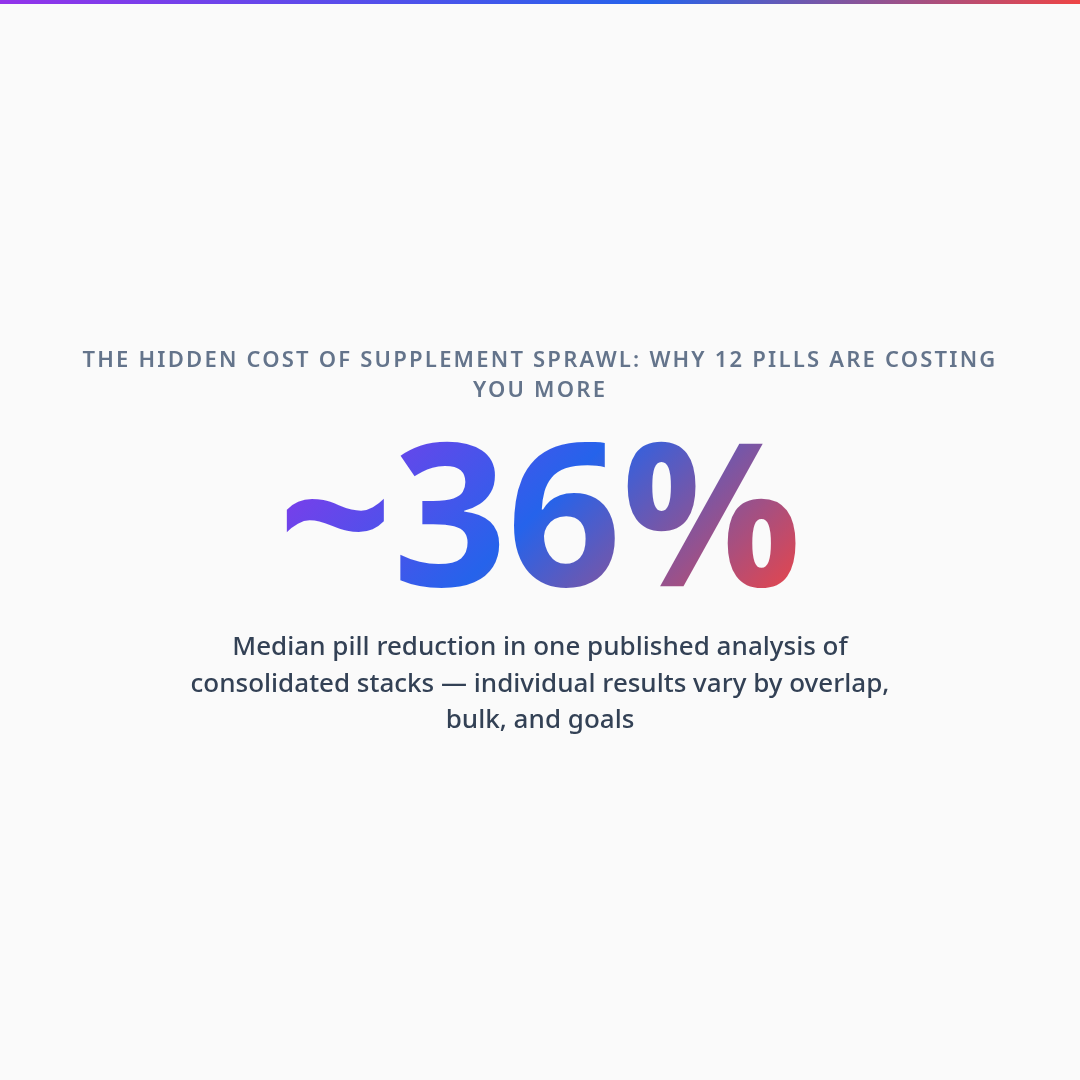
In one published analysis of consolidated stacks, median pill reduction was approximately 36% per day without reducing the breadth of nutritional coverage — but actual reductions in your own stack depend on your current overlaps, ingredient bulk (omega-3 capsules are physically large, for instance), and therapeutic goals. Some stacks see dramatically more; others see less. For one nine-product stack in that analysis, consolidation reduced the daily pill count by more than half.
For the best performers—those with the most significant overlap in their original stacks—pill reductions of 50 to 65% were achievable. These were not unusual cases; they were people who had added products gradually over several years without any systematic review.
A Consolidation Example
Note: This is a representative example based on commonly observed overlap patterns. Individual stacks vary. This is not medical advice.
Before: Consider a representative example: a person who takes a multivitamin, a separate vitamin D3, a B-complex, a fish oil, a separate omega-3 (from a greens powder), magnesium oxide, and a zinc supplement. That is seven products and eleven pills per day at a combined cost of $127 per month.
After audit: The audit reveals that his multivitamin already contains B12, B6, zinc, and 1,000 IU of vitamin D3. His greens powder contains additional vitamin C and a small omega-3 dose. His standalone zinc is putting him well above the recommended upper limit. His magnesium oxide is delivering an absorbed dose of roughly 20 mg per day despite his taking 500 mg on the label.
Consolidated stack: One comprehensive multivitamin (without D3), one targeted D3 supplement at an appropriate dose, one high-quality fish oil, and magnesium glycinate replacing the oxide. Four products, six pills per day, roughly $72 per month—while delivering the same (and in some cases better) nutritional coverage.
In one analysis of a representative ten-product supplement stack, six separate products contained vitamin C, four contained B12, and three contained zinc. The person had no idea they were tripling their intake of several nutrients.
How to Audit Your Own Supplement Stack
You do not need a nutritionist or a laboratory to identify the core patterns of supplement sprawl. The following five-step process works with nothing more than your current supplement labels and a spreadsheet.
Step 1: Lay Out Everything You Take
Include every product: daily multivitamins, standalone vitamins and minerals, protein powders, greens or reds powders, probiotics, collagen, adaptogens, and anything else you take regularly. If it has a Supplement Facts panel, it belongs in the audit.
Step 2: Extract Every Ingredient and Its Dose
For each product, list every ingredient in the Supplement Facts panel along with the amount and unit. This step takes time but is the core of the audit. You are building a master list of everything entering your body across all products.
Step 3: Identify Overlap
Group your master list by nutrient. Any nutrient appearing in two or more products is a potential redundancy. Pay particular attention to:
- Vitamin D. Multivitamins almost universally contain D3. Standalone D3 is the single most common redundant purchase.
- B vitamins. Multivitamins and B-complexes cover the same territory. If you have both, you are doubling up on the entire B family.
- Vitamin C. Found in multivitamins, greens powders, immune formulas, and antioxidant blends. Easy to find in four separate products.
- Zinc. Common in multivitamins and also added to immune, testosterone, and prostate formulas. Cumulative dosing can exceed safe upper limits.
- Magnesium. Often in multivitamins, sleep formulas, and muscle recovery products simultaneously.
Step 4: Check the Bioavailability of Each Form
Overlap is not the only problem. For each nutrient in your stack, check which form you are actually taking. A magnesium supplement and a multivitamin both containing magnesium is redundancy—but if both use magnesium oxide, the consolidated answer is not just fewer products but a better form.
Use the FormulaForge classification as a quick reference:
- Premium forms (score 85+): Highest-bioavailability forms for the nutrient (e.g., magnesium glycinate, methylcobalamin, ubiquinol, methylfolate, vitamin D3).
- Standard forms (score 70-84): Well-absorbed with strong research support (e.g., magnesium citrate, hydroxocobalamin, ubiquinone).
- Alternative forms (score typically under 70): Low-bioavailability or commodity-grade forms flagged in the FormulaForge system (e.g., magnesium oxide, cyanocobalamin, folic acid for MTHFR-variant individuals).
If your stack contains Alternative (commodity-grade) forms, consolidation is an opportunity to upgrade, not just reduce.
Step 5: Redesign Around What You Actually Need
With your overlap map and form audit complete, identify the minimal set of products that delivers full coverage of every nutrient you actually need, at a Premium or Standard score band, without duplication. This is your target consolidated stack.
Use the FormulaForge Supplement Audit Tool
If the manual process sounds time-consuming, our supplement analysis tool automates it. Upload your current labels (or scan the bottles with your phone) and FormulaForge will map every ingredient across every product, flag overlaps and unsafe cumulative doses, and suggest a consolidated alternative that maintains full nutritional coverage.
Supplement sprawl is not a purchasing problem — it is an information problem. When you can see every ingredient across every bottle in one view, the redundancies become obvious. Consolidation follows naturally.
When Not to Consolidate: Important Cautions
Consolidation is not always the right answer. There are genuine situations where a broader supplement protocol is medically appropriate and where reduction would be counterproductive.
Medically Supervised Protocols
If a physician or registered dietitian has prescribed a specific supplement regimen for a documented deficiency, chronic condition, or post-surgical recovery, do not attempt consolidation without consulting them. Some therapeutic protocols require doses and forms that standard consolidated products do not provide.
Form-Specific Therapeutic Needs
Certain health situations call for a specific ingredient form that may not be available in a consolidated product. Magnesium threonate for cognitive support, for example, cannot simply be swapped for magnesium glycinate in the context of brain-targeted supplementation—they have different tissue distribution profiles. The 80/20 rule applies: consolidate the redundant majority, and preserve the intentional minority.
Timing and Absorption Separation
Some nutrients are best taken at different times of day for optimal absorption or to avoid competition. Calcium and iron, for example, compete for the same transport pathway and are better taken separately. Iron and vitamin C are best taken together, as vitamin C enhances iron absorption. Consolidation should account for these timing considerations, not just ingredient counts.
Quality Variance Between Products
If you are currently sourcing a specific nutrient from a brand with higher-quality controls—third-party tested, NSF-certified, pharmaceutical grade—consolidating into a lower-quality product to reduce pill count is the wrong trade. Fewer pills is not the goal. The goal is fewer pills at the same or better quality. Do not consolidate down to a lower standard.
Frequently Asked Questions
How do I know if I have supplement sprawl?
The clearest signal is if you are taking five or more separate supplement products and have never audited them together as a system. Additional signs include taking a multivitamin alongside standalone vitamins that are already in it, taking more than one product that claims to support the same health area (e.g., two different “energy” formulas), or not being entirely sure what every product you take contains. A five-minute label audit is usually enough to reveal significant overlap.
Is it safe to take fewer supplements?
In the context of supplement sprawl, reducing product count is generally safe and often beneficial. The goal of consolidation is not to take fewer nutrients but to take the same nutrients through fewer, better-coordinated products. For situations involving medically supervised protocols or documented deficiencies, consult your healthcare provider before making any changes.
What is the most common overlapping supplement?
Vitamin D3 is the single most commonly duplicated supplement. Research suggests that a significant majority of people taking standalone D3 also take a multivitamin that already contains D3. Other high-overlap nutrients include B12, vitamin C, zinc, and magnesium. The overlap is rarely intentional—it accumulates one product at a time.
How much money can consolidation save?
This varies significantly depending on your current stack. In one analysis, a representative five-product stack delivering the same nutritional coverage as two consolidated products cost 63% more per month. Annualized, the difference for that particular stack exceeded $800 per year. Individual savings depend on which products you are currently buying and how much duplication exists in your current stack.
Does a personalized supplement formula replace all my supplements?
A personalized consolidated formula replaces the nutrient sources in your stack—the vitamins, minerals, and core health nutrients. It does not necessarily replace products that serve functional roles beyond basic nutrition, such as specific herbal adaptogens taken for a defined therapeutic purpose, pre-workout products, or medical foods. The consolidation process helps you identify which of your products fall into each category.
The Bottom Line
Supplement sprawl is not a sign of poor intent. It is a predictable outcome of an industry that markets products individually and a culture that encourages adding rather than optimizing. But the costs are real: financial waste, reduced compliance, unnecessary pill burden, and in some cases, cumulative intake that exceeds what is safe or useful.
The solution is not to take fewer nutrients. It is to take them more intelligently.
- Audit your stack for overlap before your next supplement purchase.
- Identify which forms in your current stack are Alternative (commodity-grade) and consider upgrading.
- Calculate the true cost per absorbed nutrient, not just the sticker price per bottle.
Research suggests that most multi-product supplement users can achieve the same or better nutritional coverage with significantly fewer pills and lower monthly cost. The audit takes one hour. The savings last all year.
Disclaimer: These statements have not been evaluated by the Food and Drug Administration. This information is not intended to diagnose, treat, cure, or prevent any disease. The content in this article is for educational purposes only and should not be considered medical advice. Please consult with a qualified healthcare professional before starting, stopping, or changing any supplement regimen. Individual results may vary.
FormulaForge was built specifically to solve supplement sprawl. Upload your labels at myformulaforge.com, see every ingredient mapped across your entire stack, and build one formula that covers everything — with the best-absorbed forms, at the doses that matter.
References and Further Reading
- Bailey, R. L., et al. (2013). Dietary supplement use in the United States, 2003-2006. Journal of Nutrition, 141(2), 261–266.
- Dickinson, A., & MacKay, D. (2014). Health habits and other characteristics of dietary supplement users: a review. Nutrition Journal, 13, 14.
- Slinin, Y., et al. (2007). Calcium, vitamin D, and cardiovascular disease. Kidney International, 72(3), S11–S16.
- Morrill, J. S., et al. (1996). Polypharmacy and Pill Burden. Archives of Internal Medicine, 156(2), 184–189.
- Schedlbauer, A., et al. (2010). Interventions to improve adherence to lipid lowering medication. BMC Family Practice, 11, 28.
- Office of Dietary Supplements, NIH. Vitamin D: Fact Sheet for Health Professionals. ods.od.nih.gov
- Whittaker, P. (1998). Iron and zinc interactions in humans. American Journal of Clinical Nutrition, 68(2 Suppl), 442S–446S.
For a deep dive on ingredient form quality, visit our Bioavailability Learning Center or explore the Ingredient Science Library.