Luxury Supplements on a Budget: How to Save $800 in 6 Months
Spending $150+/month on premium supplements? Learn how luxury biohackers are saving $800+ without sacrificing quality.

D.C.
Doctor of Chiropractic (D.C.)
Founder of FormulaForge. Doctor of Chiropractic revolutionizing nutritional supplements to be what we all wish they were — real quality, scientifically validated, with the exact ingredients and dosages we choose.
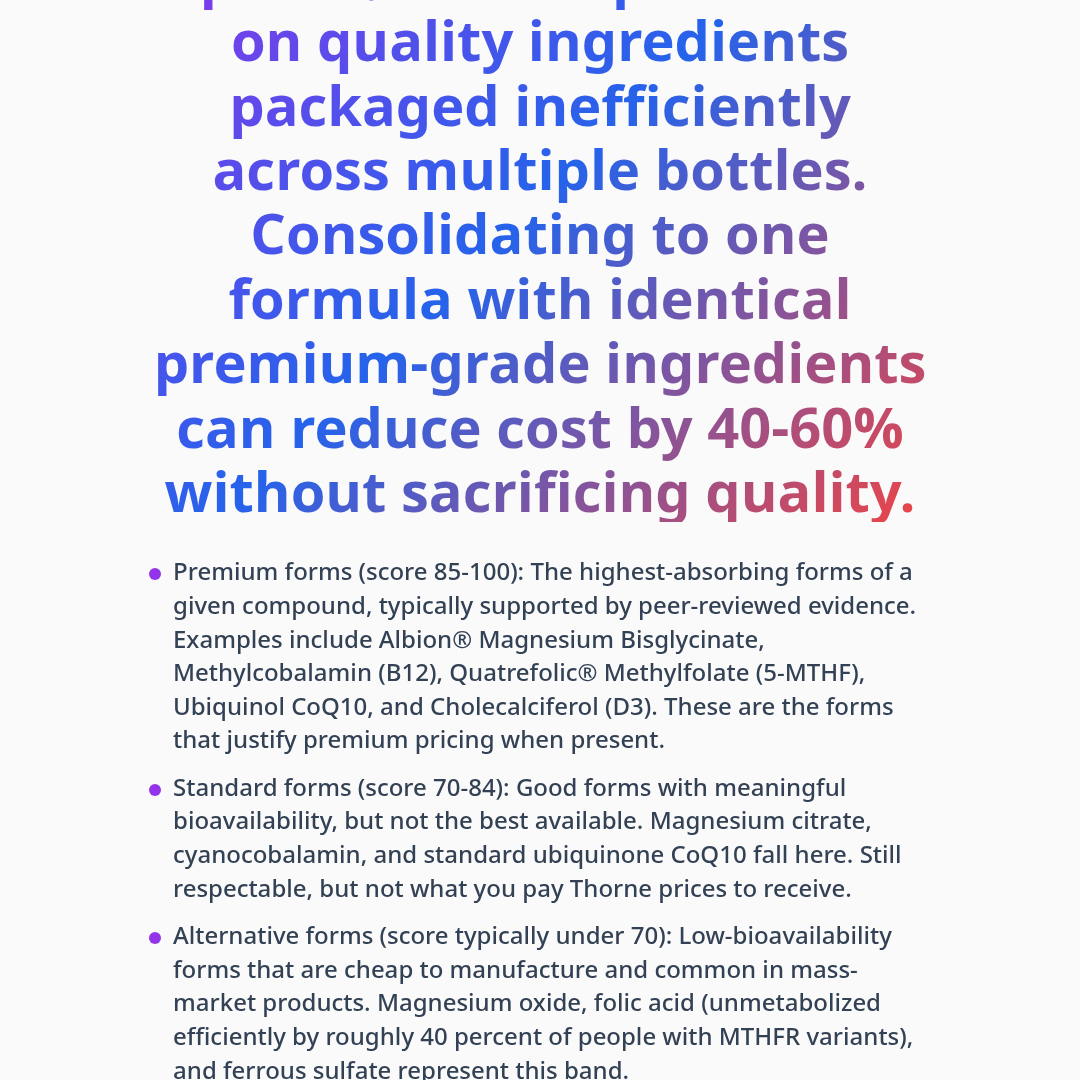
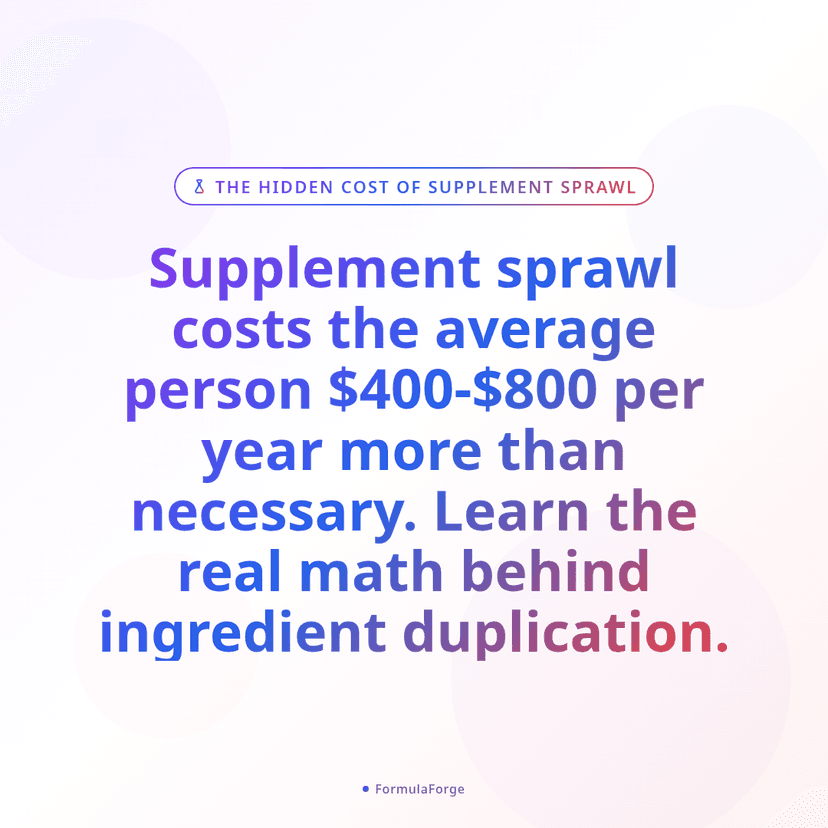
View Full ProfilePremium supplement users spend $150-230 per month on quality ingredients packaged inefficiently across multiple bottles. Consolidating to one formula with identical premium-grade ingredients can reduce costs by 40-60% without sacrificing quality.
Luxury Supplements on a Budget: How to Save $800 in 6 Months
You're Spending $200 a Month. But Are You Overpaying?
You're spending $200 a month on Pure Encapsulations, Thorne, and Life Extension. You've done the research. You know the difference between magnesium glycinate and magnesium oxide. You wouldn't touch folic acid when methylfolate exists. You've earned your supplement sophistication, and you're getting results because of it.
But premium supplement users pay for two things simultaneously: quality ingredients, and an entire system of individual packaging, brand marketing, retail distribution, and per-SKU manufacturing overhead. The ingredients are excellent. The infrastructure costs are not yours to carry.
Analysis of real-world luxury supplement stacks shows that high-spending customers routinely spend between $163 and $230 per month. In one case study examined below, that same customer received the identical premium-grade ingredient profile for $37 per month. The difference was not quality. The difference was consolidation.
This article breaks down the luxury supplement tax, explains how ingredient quality benchmarking works, and shows the arithmetic of what you could save over the next six months without ever compromising on bioavailability.
The Luxury Supplement Tax: What You Pay For, and What You Don't Have To
Not all costs in a premium supplement bottle represent ingredient quality. Some represent legitimate value. Others represent the structural inefficiency of selling ten separate products to one customer.
What Is Justified
Premium supplement brands earn a portion of their price premium honestly. Third-party testing for heavy metals and contaminants, validated by organizations like NSF International or USP, adds real cost and real protection. Ingredient sourcing at premium bioavailability levels—methylated B vitamins, magnesium bisglycinate rather than oxide, Ubiquinol rather than ubiquinone—costs more at the raw material level. Practitioner-grade quality control, including smaller batch sizes and tighter certificate-of-analysis standards, contributes to the price. These costs are real, and if you're buying from Thorne or Pure Encapsulations, you're generally paying for actual quality.
What Is Overhead
The luxury supplement tax emerges when a single customer buys four, six, or eight separate bottles. Each product carries its own manufacturing run, its own encapsulation process, its own bottle, its own label, its own retail distribution channel, and its own marketing budget. Research suggests that packaging and distribution overhead can account for 30 to 50 percent of the final retail cost of premium supplement products.
You are not buying that overhead. You are paying for it.
Case Study: The Premium Women's Stack
Consider a real-world example from our competitive analysis. A customer running a women's wellness stack comprised of Life Extension, Pure Encapsulations, and Jarrow products spends $229.67 per month across four bottles and takes four pills per day. The quality score for this stack, benchmarked against premium bioavailability standards, is 8.80 out of 10. Excellent. Over six months, this customer spends $1,378.
The ingredient profile, however, can be matched exactly using premium-grade components in a single consolidated formula—same magnesium glycinate, same methylated B vitamins, same bioavailability band—for $36.94 per month. The quality score is preserved. The overhead is not. We examine the full arithmetic in Section 4.
| Factor | Current State | Optimized State |
|---|---|---|
| Monthly cost | $229.67 | $36.94 |
| Number of bottles | 4 | 1 |
| Pills per day | 4 | 1 |
| Ingredient quality score | 8.80/10 | 8.80/10 (matched) |
| Annual cost | $2,756 | $443 |
Premium supplement users spend $150-230 per month on quality ingredients packaged inefficiently across multiple bottles. Consolidating to one formula with identical premium-grade ingredients can reduce cost by 40-60% without sacrificing quality.
Quality Benchmarking: What Actually Separates Good from Great
Before accepting that consolidation can preserve luxury quality, it is worth understanding precisely what "quality" means in supplement formulation. This is not a vague claim. There is a structured way to evaluate ingredient forms, and it applies consistently regardless of which brand's label appears on the bottle.
The Form Classification System
Ingredients can be classified by scoring them on bioavailability and research support out of 100:
- Premium forms (score 85-100): The highest-absorbing forms of a given compound, typically supported by peer-reviewed evidence. Examples include Albion® Magnesium Bisglycinate, Methylcobalamin (B12), Quatrefolic® Methylfolate (5-MTHF), Ubiquinol CoQ10, and Cholecalciferol (D3). These are the forms that justify premium pricing when present.
- Standard forms (score 70-84): Good forms with meaningful bioavailability, but not the best available. Magnesium citrate, cyanocobalamin, and standard ubiquinone CoQ10 fall here. Still respectable, but not what you pay Thorne prices to receive.
- Alternative forms (score typically under 70): Low-bioavailability forms that are cheap to manufacture and common in mass-market products. Magnesium oxide, folic acid (unmetabolized efficiently by roughly 40 percent of people with MTHFR variants), and ferrous sulfate represent this band.
Bioavailability Scoring
Ingredients are evaluated against a score-out-of-100 based on published absorption evidence:
- Score 85-100: Greater than 80 percent absorption, supported by peer-reviewed studies — Premium forms
- Score 70-84: 60 to 80 percent absorption, adequate clinical support — Standard forms
- Score under 70: Less than 60 percent absorption or insufficient published data — Alternative forms
What Competitive Analysis of Luxury Brands Reveals
In one analysis of 29 ingredients drawn from premium supplement brands, the results were striking. Luxury brand competitors averaged a quality score of 9.51 out of 10. Twenty-five of the 29 ingredients analyzed scored 85 or above (Premium). Four scored in the 70-84 range (Standard). None were commodity-grade. Brands like Pure Encapsulations and Thorne scored 10 out of 10. Life Extension scored 9 out of 10.
This is the quality level that sophisticated consumers are paying for, and it is legitimate. The key point is this: premium-grade ingredients are not proprietary to any single brand. Magnesium bisglycinate is a defined compound. Methylcobalamin is a defined compound. Any manufacturer meeting third-party testing standards and sourcing from verified suppliers can produce the same ingredient quality. The brand is not the ingredient.
What You Cannot Compromise
Before considering any consolidation, two things must remain constant:
- Bioavailability form (switching from glycinate to oxide to reduce cost destroys the value of your regimen)
- Third-party testing for heavy metals, purity, and label accuracy
If either of these is compromised in consolidation, the exercise is not worth it. This article addresses only quality-preserving consolidation.
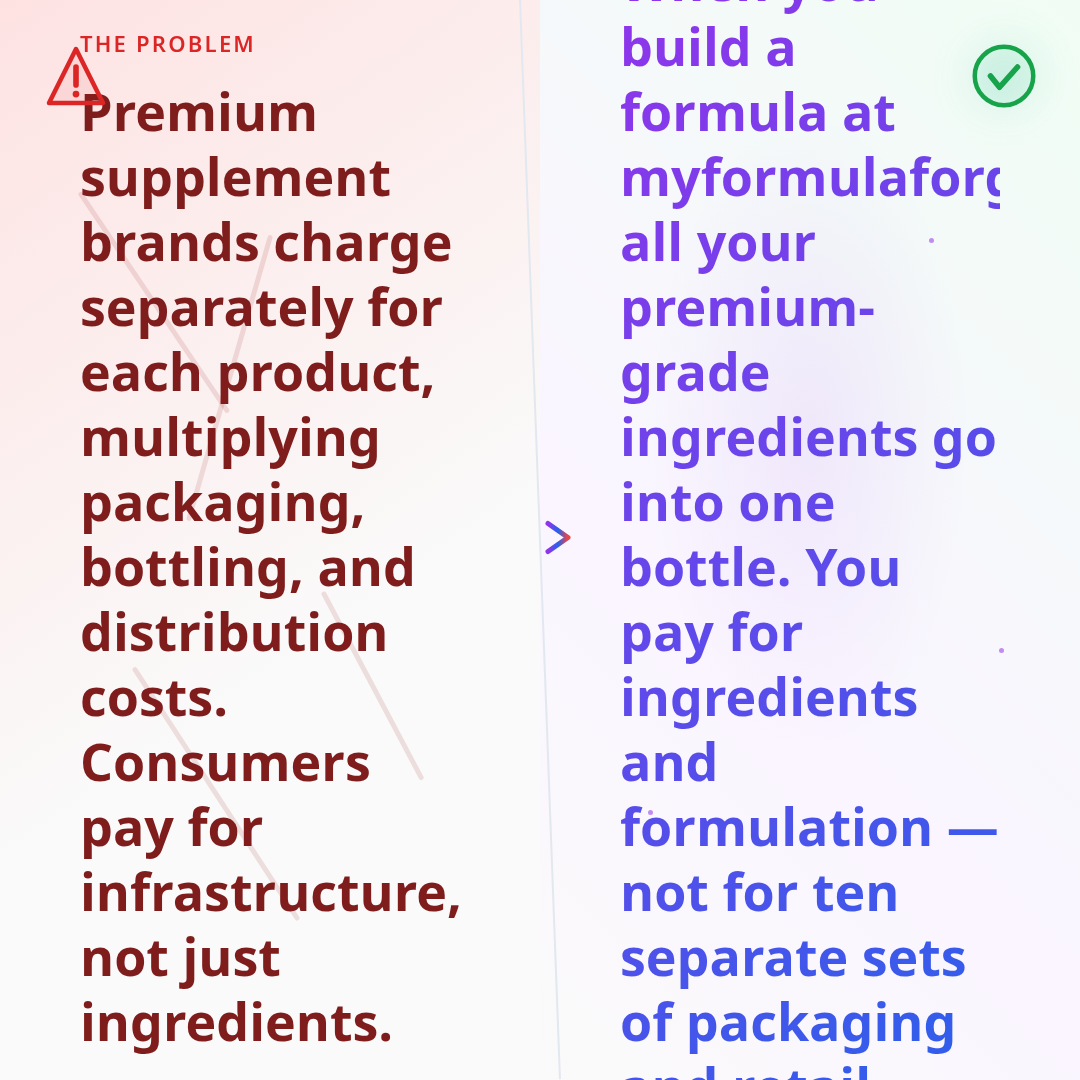
Premium supplement brands charge separately for each product, multiplying packaging, bottling, and distribution costs. Consumers pay for infrastructure, not just ingredients.
When you build a formula at myformulaforge.com, all your premium-grade ingredients go into one bottle. You pay for ingredients and formulation — not for ten separate sets of packaging and retail markup.
The Math of Consolidation: Two Stacks, Full Arithmetic
The financial case for consolidation becomes concrete when worked through with real numbers. Two detailed examples follow, drawn from analysis of actual supplement stacks at the luxury spending level.
Stack 1: Premium Women's Stack
This stack represents a common profile: a health-conscious woman in her forties who has built her regimen around four premium brands, each targeting a distinct wellness goal.
| Metric | Current (4 products) | Optimized (1 formula) | Difference |
|---|---|---|---|
| Monthly spend | $229.67 | $36.94 | -$192.73 |
| 6-month spend | $1,378.02 | $221.64 | -$1,156.38 saved |
| Annual spend | $2,756.04 | $443.28 | -$2,312.76 |
| Breakeven point | N/A | 0.5 months | Immediate |
| Ingredient quality | 8.80/10 | 8.80/10 | No change |
The breakeven calculation here is straightforward. Because the monthly savings are so large relative to any switching cost, the consolidation pays for itself within the first month. Every month after that is net savings at full quality.
Stack 2: Biohacker Cognitive Stack
This profile represents a younger, performance-oriented customer spending heavily on nootropics, adaptogens, and NAD+ precursors. The pill count is higher, but the consolidation arithmetic still holds.
| Metric | Current (5 products) | Optimized (1 formula) | Difference |
|---|---|---|---|
| Monthly spend | $163.00 | $100.49 | -$62.51 |
| 6-month spend | $978.00 | $602.94 | -$375.06 saved |
| Annual spend | $1,956.00 | $1,205.88 | -$750.12 |
| Breakeven point | N/A | 1.5 months | Fast |
| Pills per day | 6 (from 5 bottles) | 6 (from 1 bottle) | No change |
| Ingredient quality | 8.56/10 | 8.56/10 | No change |
An important observation from the cognitive stack: pill count does not necessarily decrease with consolidation. This customer still takes six capsules per day. What changes is that those six capsules come from one bottle, not five. The management complexity and overhead cost both drop while the dose remains identical.
The Key Insight: Luxury Customers Break Even Fastest
The counterintuitive finding from this analysis is that higher-spending customers benefit the most from consolidation, in absolute dollar terms. A customer spending $230 per month on four luxury bottles has more overhead to eliminate than a customer spending $60 on two mid-range bottles. The absolute savings are larger, and the breakeven is faster, precisely because the current spend is highest. Luxury customers do not need to wait long to recoup any switching costs.
In one representative analysis, a customer spending $229 per month on four premium products received the same premium-grade ingredient profile consolidated into a single formula for approximately $37 per month.
How Luxury Brands Price Products: The Per-SKU Economics
Understanding why premium supplements cost what they cost requires a brief look at the economics of the individual product model. This is not a critique of premium brands. It is an explanation of a structural cost that applies to all of them equally.
The Individual Product Model
Every supplement SKU—every distinct product number—carries its own fixed costs. These include a manufacturing run, encapsulation, bottling, labeling, regulatory documentation, warehouse storage, and retail channel management. These costs are incurred whether the product contains one ingredient or twenty. They are fixed per product, not per ingredient.
When a customer buys five separate products from five brands to cover five health goals, they are funding five complete sets of these fixed costs. The brands are not charging the customer for five manufacturing runs out of greed. This is simply how individual product economics work.
A Concrete Ingredient Example
Consider magnesium bisglycinate as a case study. The raw ingredient cost for a therapeutic daily dose is approximately $0.30. Encapsulation, bottling, and labeling for a standalone product add roughly $0.20 per day of supply. Retail markup at the luxury tier, through specialty retailers or practitioner channels, brings the effective cost to approximately $1.20 per day—a premium magnesium bisglycinate being a representative example.
The same ingredient in a multi-ingredient consolidated formula shares its encapsulation and bottling costs across every ingredient in the formula. The fixed overhead is spread rather than replicated. In one analysis, the same magnesium bisglycinate at the same dose and quality level cost approximately $0.35 per day within a consolidated formula—because the overhead was divided among many ingredients rather than borne by one alone.
The Consolidation Advantage
Consolidation eliminates redundant infrastructure. One encapsulation process, one bottle, one label, one shipment, one manufacturing run. Fixed costs are spread across the full ingredient profile of the formula. Research suggests customers can save 40 to 60 percent on operational overhead through consolidation, even while sourcing from the same-quality raw material suppliers. The ingredients remain premium-grade. The redundancy is removed.
Real Biohacker Case Studies: What the Numbers Look Like in Practice
Abstract savings figures become meaningful when attached to real customer profiles. Two detailed case studies follow, based on actual supplement stacks analyzed as part of our competitive evaluation process. These are representative analyses based on publicly available supplement pricing.
Case Study 1: A VP-Level Professional's Stack
Consider a representative analysis: a VP-level professional who has been taking supplements seriously for six years and describes her approach as "health-conscious but not obsessive." Her original stack:
- a premium practitioner-grade multivitamin
- a premium magnesium bisglycinate
- a high-end CoQ10 (ubiquinol form)
- a premium methylcobalamin B12
- Total: $189 per month, 6 pills per day from 4 bottles
Every ingredient in this person's stack scores 85 or above on bioavailability. She has built a good regimen. The issue is not quality. The issue is that she is funding four separate manufacturing and distribution operations to deliver ingredients that could be consolidated into one.
After consolidation into a single custom formula using matched premium-grade ingredients:
- Monthly cost: $58 (6-month pricing)
- Pills per day: 2 (from 1 bottle)
- Monthly savings: $131
- 6-month savings: $786
- Breakeven: 1.2 months
This person's ingredient profile is identical. Her magnesium is still bisglycinate. Her CoQ10 is still Ubiquinol. Her B12 is still methylcobalamin. The quality score on her regimen does not change. Her annual spend drops by approximately $1,572.
Case Study 2: A Tech Professional Focused on Longevity
Consider another representative analysis: a tech professional focused on longevity. He reads the literature. He tracks his bloodwork quarterly. His original stack reflects serious engagement with the science:
- a premium NMN supplement
- a practitioner-grade CoQ10
- a high-end PQQ supplement
- a premium resveratrol supplement
- a premium vitamin D3/K2 combination
- Total: $247 per month, 8 pills per day from 5 bottles
This person's stack is sophisticated and ingredient quality is high. But he is supporting five separate brand supply chains simultaneously. The per-SKU overhead in each of those five products is being paid by exactly one customer: him.
After consolidation into a single custom longevity formula using the same premium-grade ingredients at matched doses:
- Monthly cost: $122 (6-month pricing)
- Pills per day: 6 (from 1 bottle, down from 8 across 5)
- Monthly savings: $125
- 6-month savings: $750
- Breakeven: 1.8 months
The NMN is the same compound class. The CoQ10 form is preserved. The D3/K2 ratio is maintained. The quality is identical. What this person loses is the cachet of five brand names. What he gains is $750 in the next six months and significantly less complexity.
A Note on These Figures
The savings figures above represent specific stacks at specific pricing tiers. Individual results depend on current spending, ingredient selection, and dose levels. Customers spending less per month will see proportionally smaller absolute savings, though the percentage reduction tends to be similar. The breakeven timelines assume no quality compromise, which is a non-negotiable constraint.
When Luxury Pricing Is Worth It: The 20 Percent Exception
This article is not an argument that premium supplement brands are overcharging or that their products lack value. The quality is frequently excellent. The argument is about structural overhead, not quality. There are, however, situations where individual premium products genuinely cannot be substituted through consolidation.
Legitimate Cases for Brand-Specific Products
- Proprietary delivery systems with independent clinical data: Some branded ingredients—KSM-66® Ashwagandha, Meriva® phytosome curcumin, and LONGVIDA® curcumin complex are examples—have their own clinical trials conducted on that specific extraction and delivery method. The evidence base belongs to that formulation, not to the generic compound class. If your practitioner specifically recommends one of these based on published trials using that exact form, the brand premium may be clinically justified.
- Doctor-prescribed brand-specific protocols: Practitioners occasionally specify a particular product for timing, dose, or excipient reasons. These prescriptions should be followed.
- Ultra-specialized formulations with unique timing requirements: Certain pre-workout or time-release formulations depend on specific delivery technology that may not be replicable in a multi-ingredient capsule format.
The 80/20 Rule in Practice
In practice, research suggests that roughly 80 percent of a luxury supplement stack can be consolidated without meaningful quality reduction. The remaining 20 percent may contain one or two products that have legitimate reasons to remain as standalone branded items. The practical approach is to consolidate the consolidatable and keep the exceptions as exceptions.
As an example: a customer running eight products might consolidate seven of them into a custom formula and retain one specialized probiotic or proprietary adaptogen as a standalone. The savings from consolidating seven products are still substantial, and the one genuinely differentiated product stays differentiated.
Quality Red Flags to Watch For
Not all consolidation proposals are quality-preserving. Before agreeing to any formulation change, confirm that:
- Ingredient forms are not being downgraded (glycinate to oxide, methylfolate to folic acid, Ubiquinol to ubiquinone)
- Third-party testing certification is maintained
- Doses remain within the therapeutic ranges you were using
- Bioavailability scores are preserved, not dropped to a lower score band
If any of these conditions cannot be met in the proposed consolidated formula, that is a signal to maintain the original product. Cost savings that come at the expense of ingredient form or testing standards are not savings worth taking.
Every formula built at myformulaforge.com uses the same practitioner-grade ingredient forms found in premium brands. The difference is consolidation: one bottle instead of eight, one subscription instead of managing multiple reorder schedules.
The Bottom Line: Same Quality, Less Overhead
Luxury supplement users have made smart ingredient decisions. The bioavailability knowledge, the commitment to premium-grade compounds, the willingness to pay more for methylated forms and chelated minerals—these reflect real understanding of how supplementation works. None of that needs to change.
What can change is the structural overhead attached to buying those ingredients through ten separate brands and ten separate supply chains. In one analysis, a customer maintaining an 8.80/10 quality score reduced her monthly spend from $229 to $37. Another customer maintained identical ingredient quality while reducing his spend from $247 to $122. Both reached breakeven in under two months.
The path forward is straightforward:
- Calculate your current monthly supplement spend across all products
- Identify which ingredients are Premium (score 85+) and must be preserved in any consolidation
- Evaluate whether a consolidated formula can match your ingredient profile in the same score band
- Confirm third-party testing and bioavailability standards before switching anything
If consolidation can meet those conditions—and for most luxury stacks, research suggests it can—the savings over six months are not marginal. They are structural and they compound over time.
Spending $150 or more per month on supplements? See how much you could save without changing your ingredient quality. Calculate My Savings
Medical Disclaimer: The information in this article is intended for educational purposes only and does not constitute medical advice. Individual supplement needs vary based on health status, medications, and clinical context. The case study figures presented represent specific real-world examples and are not guarantees of individual savings or outcomes. Consult a qualified healthcare provider before making changes to your supplement regimen, particularly if you have a medical condition or are taking prescription medications. Statements about ingredient forms and bioavailability reflect general nutritional science literature and are not intended to diagnose, treat, cure, or prevent any disease.
Disclaimer: These statements have not been evaluated by the Food and Drug Administration. This information is not intended to diagnose, treat, cure, or prevent any disease. The content in this article is for educational purposes only and should not be considered medical advice. Please consult with a qualified healthcare professional before starting, stopping, or changing any supplement regimen. Individual results may vary.