Best Time to Take Supplements: The Timing Guide
You've been swallowing your multivitamin with your morning coffee for years. Your magnesium sits on your nightstand. Your fish oil capsules live in the fridge, and you take them... whenever you remember. But here's what nobody tells you at the su...

D.C.
Doctor of Chiropractic
Founder of FormulaForge. Doctor of Chiropractic revolutionizing nutritional supplements to be what we all wish they were — real quality, scientifically validated, with the exact ingredients and dosages we choose.
View Full ProfileReviewed by Dr. Brennan Commerford, DC
Most people take all their supplements at once with breakfast and call it done. But supplement timing genuinely matters — fat-soluble vitamins need dietary fat for absorption, magnesium works better at night, iron is destroyed by calcium, and B vitamins taken before bed can interfere with sleep. This guide organizes the research by supplement category, explains the mechanisms behind each timing recommendation, and cuts through the overcomplication that surrounds this topic.
Why Timing Actually Matters
In clinical practice, I noticed that supplement timing advice often fell into one of two failure modes: it was either ignored entirely ("just take everything with breakfast") or overcomplicated to the point of paralysis. Neither extreme serves patients well.
The truth is that timing matters meaningfully for a subset of supplements — and for others it barely matters at all. The key is knowing which is which, and why. Mechanism-based reasoning cuts through the noise faster than memorizing a list of rules.
There are four primary reasons supplement timing affects clinical outcomes: absorption requirements (fat-soluble vs. water-soluble, food vs. fasted state), competitive absorption interactions (minerals sharing the same transporters), circadian biology (hormones and neurotransmitter systems follow daily rhythms that affect how certain supplements work), and gastric tolerability (some supplements irritate an empty stomach).
Fat-Soluble Vitamins: Always With a Fat-Containing Meal
Vitamins A, D, E, and K are fat-soluble, meaning they require dietary fat present in the gut lumen for absorption through micellar incorporation. Taking these without food — or with a fat-free meal — meaningfully reduces absorption.
A 2010 study in the Journal of the Academy of Nutrition and Dietetics demonstrated that Vitamin D3 absorption was 32% higher when taken with the largest meal of the day (highest fat content) compared to a low-fat meal. A separate 2015 study specifically found that taking Vitamin D with avocado or nuts — high-fat, lower-calorie foods — significantly increased 25-hydroxyvitamin D levels compared to taking it in a fasted state. The practical implication is consistent: fat-soluble vitamins should always be taken with food containing meaningful fat content.
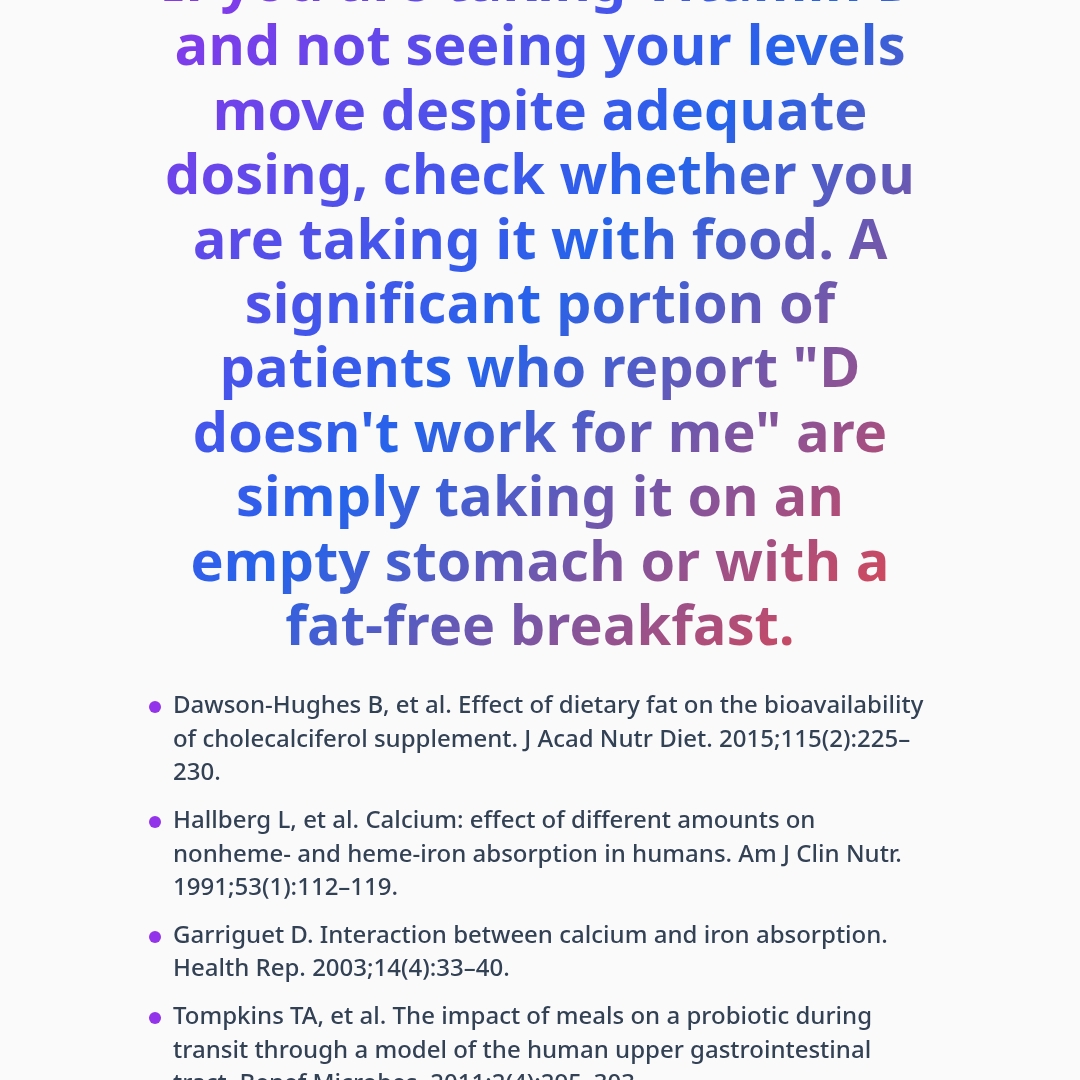
If you are taking Vitamin D and not seeing your levels move despite adequate dosing, check whether you are taking it with food. A significant portion of patients who report "D doesn't work for me" are simply taking it on an empty stomach or with a fat-free breakfast.
Magnesium: Evening Is Better Than Morning
Magnesium is one of the clearest timing cases in clinical supplementation. The mineral has well-documented relaxation effects on the nervous system — it inhibits excitatory NMDA receptors, supports GABA activity, and lowers cortisol. These properties make it particularly well-suited to evening use, where they align with the physiological wind-down for sleep.
Taking glycinate in the evening is not merely a preference — it is a timing strategy backed by mechanism. Patients who switched from morning to evening magnesium in clinical practice frequently reported improved sleep within one to two weeks, without any dose change. The mineral was the same; the circadian alignment made the difference.
B Vitamins: Morning, With Food
B vitamins are water-soluble and used as enzyme co-factors in energy metabolism, neurotransmitter synthesis, and methylation. Their energizing effects — particularly those of B12, B6, and folate — make morning timing the practical default. Taking B vitamins in the evening, particularly B12 and high-dose B6, has been associated with sleep disruption in some individuals due to increased dopamine and norepinephrine synthesis.
Vitamin B12 absorption is particularly sensitive to timing and conditions. The intrinsic factor-dependent absorption pathway is saturable at approximately 1.5–2 mcg per dose — meaning a 1000 mcg B12 supplement primarily relies on passive diffusion (~1% efficiency) for the majority of the dose. This is not a timing issue per se, but it means that splitting B12 doses (or using sublingual forms for improved mucosal absorption) can matter more than what time of day you take it.
Iron: Separated From Calcium and Dairy
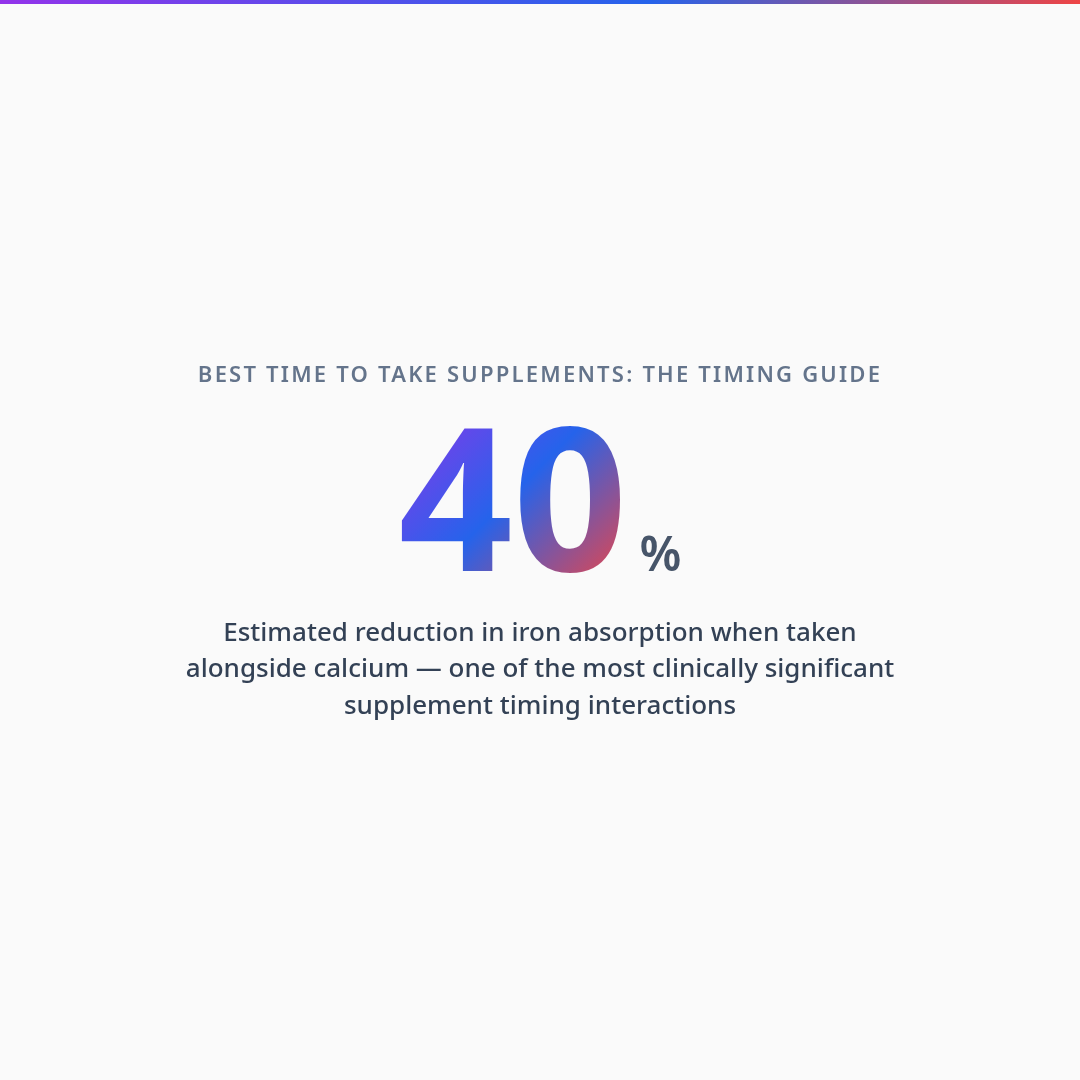
Iron has one of the most clinically significant timing interactions of any common supplement. Calcium — whether from dairy, calcium carbonate supplements, or calcium-fortified foods — directly competes with iron for intestinal absorption via the divalent metal transporter (DMT1). The interaction is dose-dependent: studies show 40–60% reduction in iron absorption when taken with 300–600 mg of calcium.
Never take iron and calcium at the same meal. This is not a minor consideration — it is one of the most evidence-supported supplement interactions in clinical nutrition. Individuals supplementing with iron who take it alongside dairy or calcium supplements may be absorbing less than the intended amount. Those who take their iron supplement with dairy or a calcium supplement are frequently achieving a fraction of the intended therapeutic dose. Separate by a minimum of 2 hours.
Zinc: Not With High-Fiber Meals or Dairy
Zinc shares the divalent metal transporter with iron — meaning these two minerals compete for absorption. Patients taking both iron and zinc therapeutically should separate them by at least two hours. Phytates (in whole grains, legumes, and seeds) significantly reduce zinc absorption; high-fiber meals represent a timing challenge for zinc supplementation.
Omega-3s: With the Largest Meal
Fish oil and other omega-3 supplements are fat-soluble and benefit from co-ingestion with dietary fat for the same reasons as fat-soluble vitamins. Additionally, taking omega-3s with food reduces the most common complaint — the "fish burp" or reflux that patients report with fasted omega-3 use.
Vitamin C: Spread Throughout the Day
Vitamin C is water-soluble and subject to intestinal saturation. At high doses (above 500–1000 mg at once), absorption efficiency drops significantly and excess is excreted in urine. Patients taking therapeutic doses of Vitamin C for immune support or as an antioxidant are better served by splitting the dose across two to three meals throughout the day.
Probiotics: The Meal Timing Debate
Probiotic timing is one of the more contested areas in supplement science. The central question is whether stomach acid destroys probiotic organisms before they reach the colon. The answer depends on the strain, the formulation, and what you ate.
A 2011 study in Beneficial Microbes examined probiotic survival under different meal conditions. Organisms in the Lactobacillus and Bifidobacterium genera survived in higher numbers when given 30 minutes before a meal or with a meal containing fat or carbohydrate — conditions that buffer stomach acid and accelerate gastric emptying. Fasted administration and administration immediately after eating showed lower recovery. The practical recommendation: take probiotics 30 minutes before breakfast, or with a small meal.
Timing Interactions: What Should Never Go Together
The Simple Protocol: A Starting Point
For patients managing multiple supplements, here is a practical baseline timing protocol that addresses the most significant interactions without requiring a pharmacology degree:
Chronopharmacology — the study of how time of day affects drug and nutrient absorption and efficacy — is an active research area that has historically been applied mainly to medications (statins at night, blood pressure medications in the morning) but increasingly applies to nutraceuticals. Cortisol peaks in the early morning and drops in the evening, which is one reason magnesium, ashwagandha, and phosphatidylserine are better timed in the evening when you want to modulate the cortisol-stress axis downward.
The FormulaForge analysis engine at myformulaforge.com doesn't just check what is in your supplements — it checks how they interact with each other. When you analyze your full supplement stack, the system flags timing conflicts (iron + calcium in the same product line, fat-soluble vitamins without dietary fat in the protocol), identifies absorption interactions across your entire regimen, and generates a timed dosing schedule that resolves the conflicts. This is the kind of analysis that previously required a clinical pharmacist or a well-read nutritionist to provide.
The timing recommendations in this article apply to standard supplemental doses. Patients on therapeutic-dose protocols (high-dose iron protocols directed by a physician, pharmacological Vitamin D replacement, etc.) should follow their prescribing physician's specific instructions, which may differ from general timing guidance. Supplement timing interactions are additive across a day — a patient taking multiple supplements with overlapping absorption pathways may need more individualized scheduling. This article does not constitute medical advice.
Frequently Asked Questions
Most supplement timing advice is overcomplicated — the core rules that actually matter are: take fat-soluble vitamins (A, D, E, K) and omega-3s with fat-containing meals; put magnesium glycinate in the evening; separate iron and calcium by at least 2 hours; take B vitamins in the morning; and take probiotics 30 minutes before eating. These five rules resolve the most clinically significant timing issues for the majority of supplement users. Everything else is optimization. Consistency with your supplements matters more than perfect timing.
This article is intended for educational and informational purposes only and does not constitute medical advice. The information provided here is not a substitute for professional medical advice, diagnosis, or treatment. Always seek the guidance of your physician or other qualified health provider with any questions you may have regarding a medical condition or supplement regimen. These statements have not been evaluated by the Food and Drug Administration. Dietary supplements are not intended to diagnose, treat, cure, or prevent any disease.
- Dawson-Hughes B, et al. Effect of dietary fat on the bioavailability of cholecalciferol supplement. J Acad Nutr Diet. 2015;115(2):225–230.
- Hallberg L, et al. Calcium: effect of different amounts on nonheme- and heme-iron absorption in humans. Am J Clin Nutr. 1991;53(1):112–119.
- Garriguet D. Interaction between calcium and iron absorption. Health Rep. 2003;14(4):33–40.
- Tompkins TA, et al. The impact of meals on a probiotic during transit through a model of the human upper gastrointestinal tract. Benef Microbes. 2011;2(4):295–303.
- Abbasi B, et al. The effect of magnesium supplementation on primary insomnia in elderly. J Res Med Sci. 2012;17(12):1161–1169.
- Javanbakht MH, et al. Randomized controlled trial using vitamins E and D supplementation in atopic dermatitis. J Dermatolog Treat. 2011;22(3):144–150.